
A Week in the Life of a Flower Farmer
A Week in the Life of a Flower Farmer
A Week in the Life of a Flower Farmer
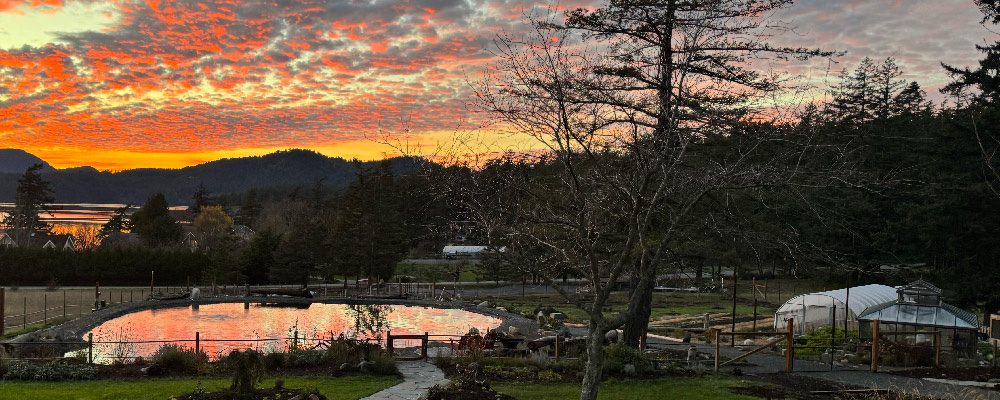
When we started The Little Farm on Olga Road, our intention was to take a permaculture approach to growing fruit, berries, veg and perennial flowers. But then I took Floret’s online flower farming course. Utterly smitten with the idea, I pivoted hard towards farming flowers. We still employ permaculture principles such as capturing water and using that water to irrigate the farm and employing organic fertilizing and pest management practices. Three years later, our three-acre farm is shaping up and I am anticipating a warmer spring and a hot summer. Soil temps are already nearing 50 on our farm and as soon as the soil hits 60, the farm will explode with flowers.
If you drive or stop by our farm to pick up a bouquet or just to say hi, we will be out there toiling. To give you a window into my world, I thought I’d share the work we are engaging in right now to prepare the farm for all the glory to come.
Growing Seeds and Planting Plugs
I started my sweet peas, pansies, violas, ranunculus, anemones and tulips last fall. They are all doing great, especially since I mulched like crazy and used frost cloth in our hoops to save the ranunculus and anemones, which don’t like anything below 23 degrees. The sweet peas got beat up by fierce freezing winds, but when I pulled up a start yesterday, it’s roots were growing deep and strong. My glass greenhouse has snapdragons, stock, yarrow, and calendula already up and at it. This week I start bachelor buttons, anise hyssop, asters, strawflower and more. And then mid-March I will start amaranth, basil, celosia, cosmos, zinnias and about a dozen other annuals I couldn’t resist. Seeds are like shoes for me. This season, I leaned into Johnnie’s Seeds and Baker Creek Seeds and now need to make tough decisions about bed space and the 100 packets of seeds I currently have that could easily plant 10 acres. If you need specialty seeds, I am happy to share.
Digitalis, larkspur, foxglove and eryngium plugs are all tucked in their beds and dispersed through my perennial borders. I get my plugs from Farmer Bailey, which is a consolidator for a bunch of growers. I have found their plugs to be top notch. The challenge is you wind up with 125 to 285 plugs, which is way too many to plant. For instance, I have 285 plug flats of gomphrena, campanula, and nigella coming. Did you know you can plant 3 nigella plugs in one hole? Spaced 6” apart, that means I can easily fit 285 nigella plugs in a ten-foot bed. Yeah! Another plug I like buying from Farmer Bailey are lisianthus, which are characteristically challenging to grow by seed as germination takes super long and lord, if you forget to water one day, you are positively sunk. Get the plugs.
Freaking on Weeds and Pruning Back Perennials
If I were to write a book it would have to be titled, Weed Freak. Anyone who has visited our farm often observes that it’s tidy and almost entirely weed free. We do not spray our weeds with herbicides. We weed by hand, usually me, and mulch like crazy. Nature loves a vacuum and will happily fill all vacuums with weeds, so I have hit this farm hard, making weeding my daily meditation and recently, as we get busier and busier, I am getting help, which is glorious. My other strategy is to cover every inch of this property with plants. Perennials are my favorite, and I cram in the plants to grow more flowers, but also to shade out the life sucking weeds.
Because it’s getting warm, and quick, yesterday I started pruning back dead foliage from my perennials, even though a British woman I watched on YouTube implored me to not cut back my guara until April. I can’t help myself; the pruning has begun. Yesterday, Allan gave our wine grapes a major pruning. Basically, choose the main trunk, cut everything off unless it has an obvious cordon turning on to a wire. We are also treating for blister mites on the grapes with monthly sprays of Neem oil. I just discovered a scourge of aphids on my ranunculus in our smaller hoop house, which I let get too warm. They just got Neem as well.
Bed Prep and the Wonders of Compost Tea
One thing about weeding by hand is you really see what’s going on with your soil. After three years of really working our soil, I now find it dark and loamy and teaming with worms. The key method I have employed is applying compost tea in both root drenches and foliar spray. I am making 25-gallon batches of tea a week and adding fish and seaweed to that mix and foliar spraying like a mad woman. Now is the time! I am also experimenting with adding unsulfured molasses to my foliar spray. The thinking is that molasses will raise the Brix levels of my plants, which warns off pests. We will test to see if our plants wind up with elevated Brix levels, basically elevated sugar levels. Experimenting is our jam.
Cleaning Up Our Well Water and Wobblers
As soon as the rains subside, we use well water to irrigate. To avoid unnecessarily pulling from ground water during drought conditions we switch over to irrigating with the water we capture in our big pond. Our well water is full of iron, which makes absorption of all those yummy nutrients in the soil difficult for plants to take up and utilize. Last year we installed a BIGboy™ Dechlorinator & Sediment System and recently we installed a second filter, BIGboy™ KDF85/Catalytic Carbon Filter, which reduces up to 99% of chlorine, sulfur, iron, heavy metals, rust and silt. We are eager to see how these variables play in helping my annuals this year. Perennials don’t seem to care much about anything, flourishing in crappy soil and drought conditions.
With exception to the sweet peas, another new irrigation method we are employing is removing all irrigation lines. Instead, we are installing a wobbler irrigation system that will sprinkle water out like rain starting at 2:00am and in shifts around the farm. We will keep an eye out for powdery mildew, but I am excited to get rid of irrigation lines where we can. Hoops and sweet pea patch will still have irrigation lines. Sweet peas absolutely hate to be sprinkled.
So… That’s This Week!
To learn more about all that we are doing on The Little Farm, visit our website at littlefarm.life and follow us on Instagram @littlefarmorcas and @littlefarmsoapco where we are making 100% grassfed tallow based soaps and skincare. Never a dull or idle moment. Yes, we are “Out of Our Bloomin’ Minds”. When particularly spent and exhausted, I ask myself, exactly what are you avoiding by farming every second of every day. My answer is always, with everything going on in the world, I take great solace in working with dirt. Long ago, upon my return from a fundamentalist summer camp, where it was suggested both my parents were going to hell, my atheist mother said, “Carol. God is in the garden!” Indeed, she is. Carol
.
